
It’s Never Too Late: Tools, Hope, and Love for the Adult Pianist
Minor 7 Chords On The Piano
A Major Companion
Minor 7th Chords: A Major Companion

Of all the chords you will ever see or play, the majority of them will either have a Major or minor quality. We have already covered the Major 7th and dominant 7th chords, both of which are Major quality chords. Well, we might think of minor quality chords as the counterparts to those majors. Major and minor quality chords are essentially the “yin and the yang” of music harmony.
What Makes A Chord Major Or Minor? Think “3rd”
We haven’t gotten into much theory at all during our journey with learning these chords because the goal has been to gain quick access to them without being distracted. However, it will be relevant to know this at some point. We can think of chords, which are actually segments of scales, as actually representing scales (thus the phrase chord-scale relationships). For example, a Cmaj7 chord actually consists of the 1, 3, 5, and 7 of the C Major scale.
Take a good look at the C Major scale:
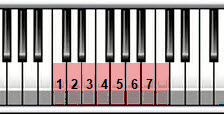
You will notice that any C Major chord we have learned has included the #3 (E) of the C Major scale. That 3, we could say, is the “magic number.” The interval between the root C and this E is 4 half steps. This would be true of all Major scales, since music is mathematically consistent.
Any C minor chord we have learned has actually included the Eb, which is 3 half steps away from the root:
C minor scale
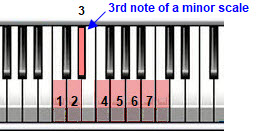
So, you see, when we play a Major chord, we are actually implying a Major scale. When we play a minor chord, we are actually implying a minor scale.
It is the 3rd of a scale that actually determines whether a chord is major or minor.
Okay, let’s move on to creating a minor 7 chord…
Let’s take a look at that C7 chord again:

Just One Minor Change – Literally
Do you see that note above the root? We are simply going to lower it one half step, like this:

Pretty easy, yes?
So, one way of arriving at a minor 7 chord in root position is to play a dominant 7 chord and lower that note above the root by one half step.
Different Ways Of Arriving At The Same Place
By now, you’ve probably deciphered that there are a number of ways to arrive at a chord by making adjustments to chords that are already known to us. As you may have already noticed, for example, you can play a minor triad and simply add the note that is one whole step below the root and then move that note up an octave. We did this originally when discussing the Major 7 and dominant 7 chords. Of course, as we have mentioned numerous times, these are all just temporary visual approaches to arrive at these chords. The instant identity of these chords will be your experience before long.
The Minor 7 Chord In Context Of A Lead Sheet
Let’s look at an example of how you will see the minor 7 chord in a musical context using an excerpt of Joseph Kosma’s very popular Autumn Leaves:

Take notice of the chord symbol Cm7. It’s important to use a lower case “m” since we don’t want to confuse the quality of the chord with major (which would use an upper case “M”).
It’s easy to see in the excerpt above how the minor 7 chord plays a rather balanced role along with the dominant 7 and major 7 chords.
Take It Further
Okay, you are really coming along with these 7th chords! You’ll want to play more root position minor 7 chords on these roots:
C F B♭ E♭ A♭ D♭ G♭ B E A D G
We have covered quite a bit of territory. You should be feeling pretty good about yourself!
Know Your 7th Chords

We’ll take a look at major 7ths, dominant 7ths, minor 7ths, diminished 7ths, and more. This simple, 9-minute video will break down 7th chords in a way that’s easy to grasp, giving you the confidence to play your favorite standards with ease.